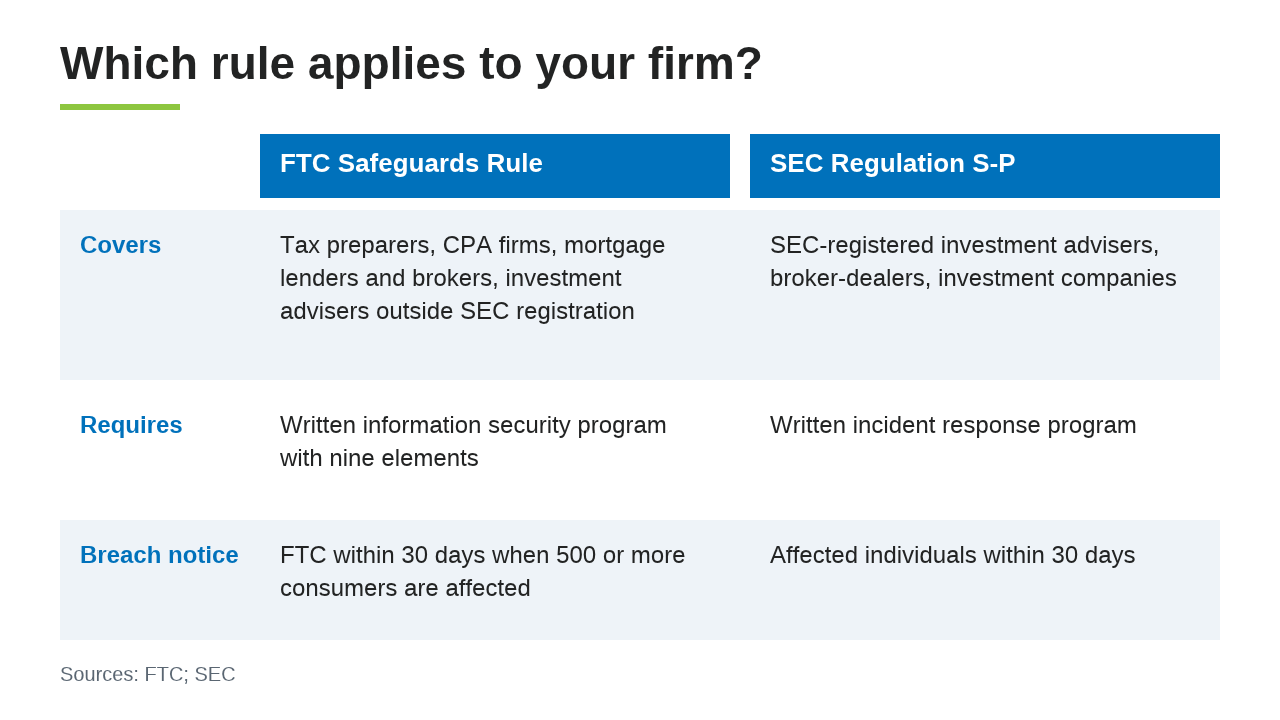
The regulator that applies to your firm depends on what your firm does. Tax preparers, CPA firms, mortgage brokers and investment advisers outside SEC registration follow the FTC Safeguards Rule. SEC-registered investment advisers, broker-dealers and investment companies follow Regulation S-P. Both rules require a written security program and a breach notice within 30 days. WEBIT Services implements and documents the technical safeguards for financial firms across Chicagoland, and your compliance officer and counsel keep the final compliance decisions.
Which financial firms fall under the FTC Safeguards Rule?
The FTC defines a financial institution by its activities. Covered examples include tax preparation firms, mortgage lenders and brokers, account servicers, collection agencies, credit counselors and other financial advisors. The FTC exempts firms holding information on fewer than 5,000 consumers from certain provisions.
What does the FTC Safeguards Rule require?
The rule requires a written information security program with nine elements:
- A designated Qualified Individual
- A written risk assessment
- Safeguards that include access controls, encryption and multi-factor authentication
- Monitoring and testing, through continuous monitoring or annual penetration testing plus vulnerability scans every six months
- Staff security training
- Oversight of service providers, built into contracts
- A program kept current as your operations change
- A written incident response plan
- A written annual report from the Qualified Individual to your board or senior officer
The Qualified Individual can work for a service provider, and your firm supervises that person. Firms report a breach affecting 500 or more consumers’ unencrypted information to the FTC within 30 days of discovery.
What does SEC Regulation S-P require?
The SEC’s amendments require a written incident response program designed to detect, respond to and recover from unauthorized access to customer information. Firms notify affected individuals within 30 days of becoming aware of an incident. The program includes due diligence and monitoring of service providers, and firms keep written records of compliance. Larger entities complied by December 3, 2025, and smaller entities by June 3, 2026.
What should your IT provider own?
Your provider owns the technical evidence an examiner asks for:
- Email security and payment verification controls for business email compromise
- Multi-factor authentication, encryption and secure client file exchange
- Vendor and third-party risk documentation
- Archiving and retention support for communications
- Quarterly security scorecards for leadership and compliance
Your compliance officer and counsel keep the final compliance decisions, and your provider supplies the controls and records that support them.
How WEBIT Services supports financial firms
WEBIT aligns financial firms’ environments to NIST, documents the controls behind the written information security program, and keeps evidence ready before audit season. The financial services page lists the platforms WEBIT supports, and the financial services whitepapers go deeper. The email spoofing checker is a free first step, and the business email compromise defense plan covers wire fraud.
Sources: FTC, FTC Safeguards Rule: What Your Business Needs to Know (updated December 2024). SEC, Final Rules: Enhancements to Regulation S-P (May 2024).